
Interview with EDB
Find out more about our sponsor EDB
Any views or opinions represented or expressed in this interview belong solely to the interviewee and do not necessarily represent those of the PostgreSQL Conference Germany 2026 organization, PostgreSQL Europe, or the wider PostgreSQL community, unless explicitly stated.
In which areas do you expect PostgreSQL to grow most and how does your company contribute to and benefit from that growth?
PostgreSQL is becoming a default foundation for AI-era applications, not because it is chasing trends, but because it can anchor the system of record while also supporting retrieval, context, and governance close to the data. We expect the biggest growth in three areas: AI and agentic applications that need reliable, auditable data access; analytics and mixed workloads as teams reduce data sprawl; and hybrid and sovereign deployments where control and portability are non-negotiable.
EDB contributes upstream to make those use cases workable in production. Recent examples include PostgreSQL 18’s OAuth framework to align Postgres with modern enterprise identity patterns, dynamic extension loading to keep extensibility practical in cloud-native environments, and new index access method foundations that open the door for evolving AI and analytics access patterns. We also invest in shared guidance for the ecosystem, including our O’Reilly book, Building a Data and AI Platform with PostgreSQL. As PostgreSQL expands into these platform roles, upstream improvements compound, and we bring that engineering into the products and services we deliver to customers running Postgres at scale.
What is your PostgreSQL centered product and what makes it unique?
EDB Postgres® AI (EDB PG AI) is an open, enterprise-grade data and AI platform built on PostgreSQL. It brings together four core capabilities in one integrated stack: an enterprise-ready Postgres database for mission-critical workloads, Hybrid Management for operating Postgres consistently across cloud and on premises, AI Factory for building and running GenAI and agentic applications on governed data, and Analytics Accelerator for fast analytics alongside operational workloads.
What makes it unique is the integration. Instead of bolting on separate point tools, EDB Postgres AI keeps PostgreSQL as the foundation while combining lifecycle automation, high availability, backup and recovery, observability, and AI application building so teams can run transactions, analytics, and AI workflows without copying data into proprietary systems or creating new silos. The result is a single governed environment where organizations can scale Postgres confidently, modernize how they operate it, and build AI capabilities on top of the data they already trust.
What is your company's mission?
Our vision is a world where the next generation of intelligent systems is built on open infrastructure with sovereign control of data and AI. As AI becomes embedded in products, operations, and public services, organizations cannot treat data platforms as a black box or accept that critical workloads must live in a single vendor’s cloud. They need the ability to govern, secure, and operate data and AI wherever it makes sense, across regions and environments, without losing performance or portability.
That is why we are building around PostgreSQL, an open foundation that can evolve with new workloads while remaining reliable for the systems of record enterprises depend on. Our job is to make that foundation workable at scale so teams can move from pilots to production with a platform they can run with confidence and control.
What makes your company a great place to work?
What makes EDB a great place to work is that contributing to open source PostgreSQL is not extracurricular work–it’s the job. Engineers are encouraged to work in the open, collaborate directly with the community, and ship improvements that benefit everyone, not just our customers. In 2025 we counted 32 recognized contributors in our ranks, including 7 committers. The 165 speaking sessions and sponsorship of 18 community conferences reflect how deeply participation is baked into the culture here.
That commitment extends beyond core Postgres. EDB helps build and support widely used projects such as CloudNativePG (a CNCF Sandbox project) and operational tooling that strengthens Postgres reliability across modern environments. We also invest in mentorship and growing new contributors, because the health of the ecosystem matters as much as any single release.
Which of your company's contributions to the PostgreSQL Project (code/community/conference) are you most proud of?
PostgreSQL 18’s OAuth 2.0 support is one of the contributions we’re most proud of, both for what it enables and for how it was built. At enterprise scale, authentication cannot depend on brittle role sync scripts or scattered credential management across clusters. OAuth provides a modern foundation for integrating Postgres into centralized identity patterns, using time-limited tokens and a clean separation between user identity and client identity.
Just as important, this was true upstream engineering: a multi-year effort shaped by deep architectural, security, usability, and interoperability review across the PostgreSQL community, plus extensive testing that improved the final design. We’re proud to have helped move it into core PostgreSQL and grateful to the many community members who challenged and strengthened it along the way.
What feature in the last PostgreSQL version benefits your company most?
In PostgreSQL 18, the feature that benefits us most is dynamic extension loading. Postgres wins because it is extensible, but modern deployments are increasingly cloud-native and locked down by design. When system directories are read-only and images are immutable, the traditional model for installing and managing extensions becomes a real operational constraint.
Dynamic extension loading is a meaningful step toward making Postgres extensibility compatible with secure, cloud-native operations. It supports a cleaner path to shipping capabilities where and when they are needed without weakening operational controls. For us, it directly improves how we build, test, and run Postgres across environments, and it helps customers adopt extensions with fewer workarounds and less operational friction.
What makes you want to attend the PGConf.DE conference?
PGConf.DE is one of the best places to engage with the PostgreSQL community in a setting that is deeply technical, practical, and honest. We come to listen and learn from operators and developers who are running Postgres in the real world, and to compare notes on what is working, what is painful, and what needs to change next. It’s also a rare chance to have high-quality conversations with contributors and maintainers about ideas early, before they harden into code, which is exactly how PostgreSQL evolves.
As a company that contributes upstream and supports key projects in the ecosystem, we value the hallway track as much as the talks. The conference helps us stay close to the community’s priorities, share what we’re learning from large-scale deployments, and build the relationships that make open source collaboration work year after year.
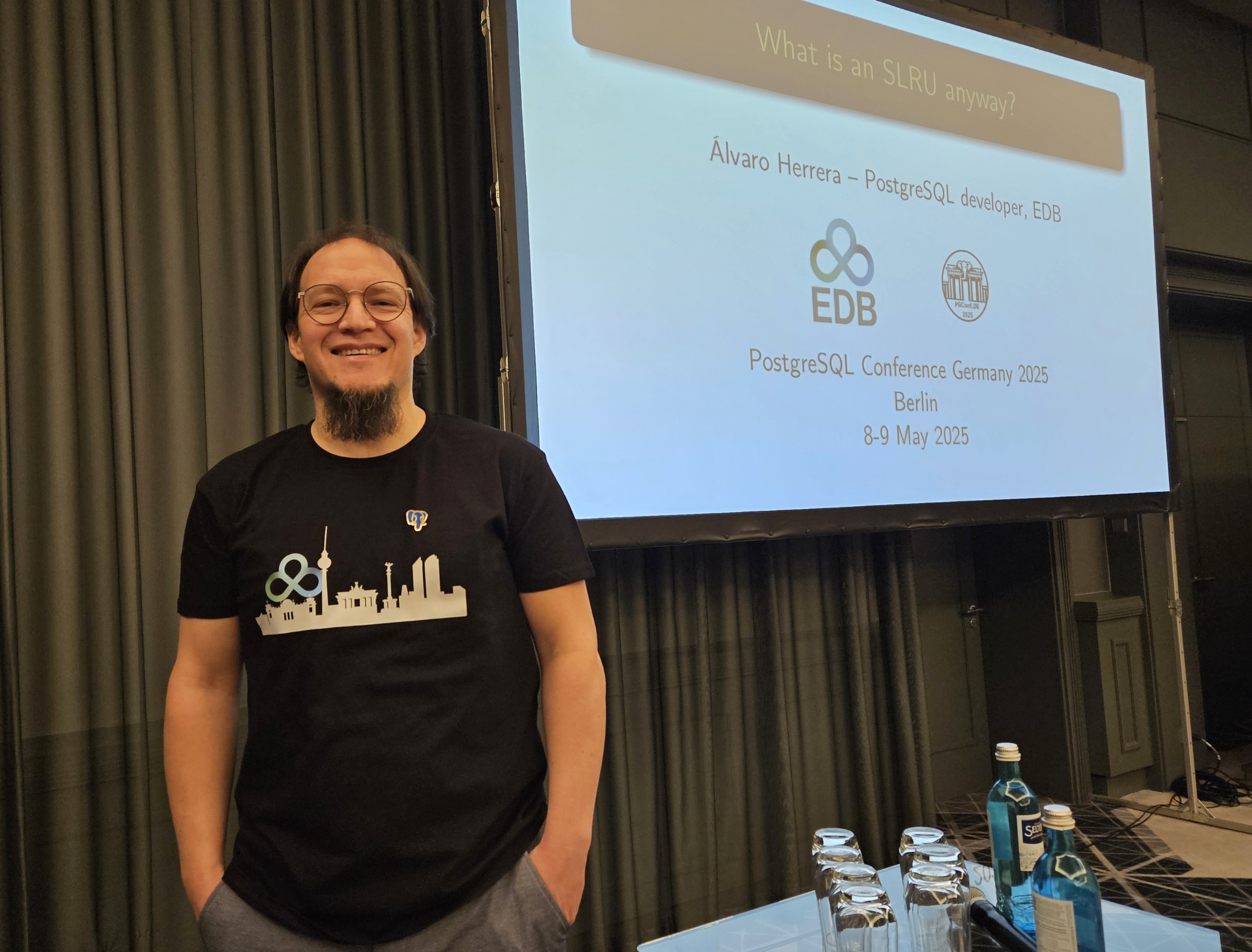 Alvaro Herrera at last year's PGConf DE
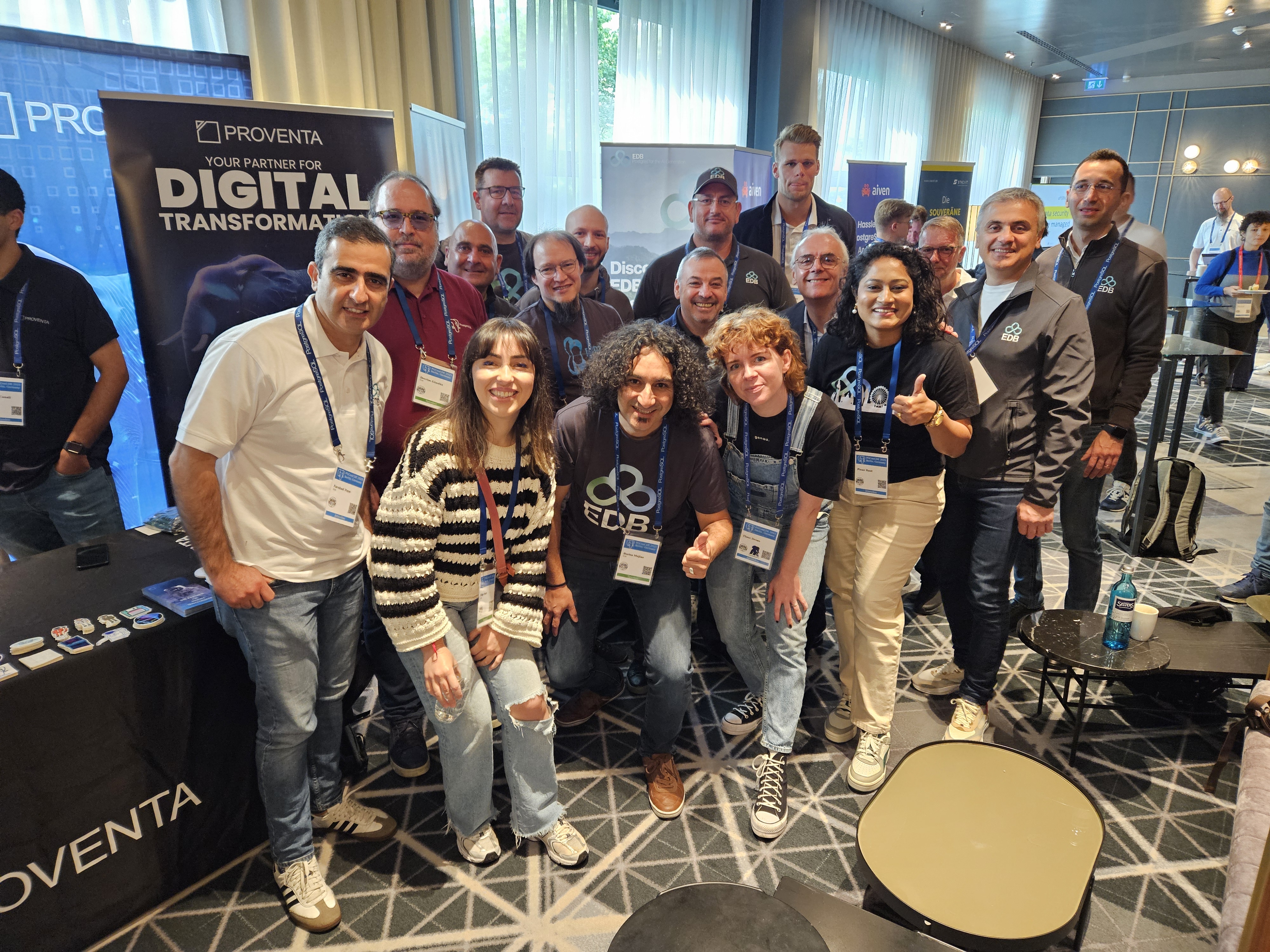 A candid team picture at last year's PGConf DE
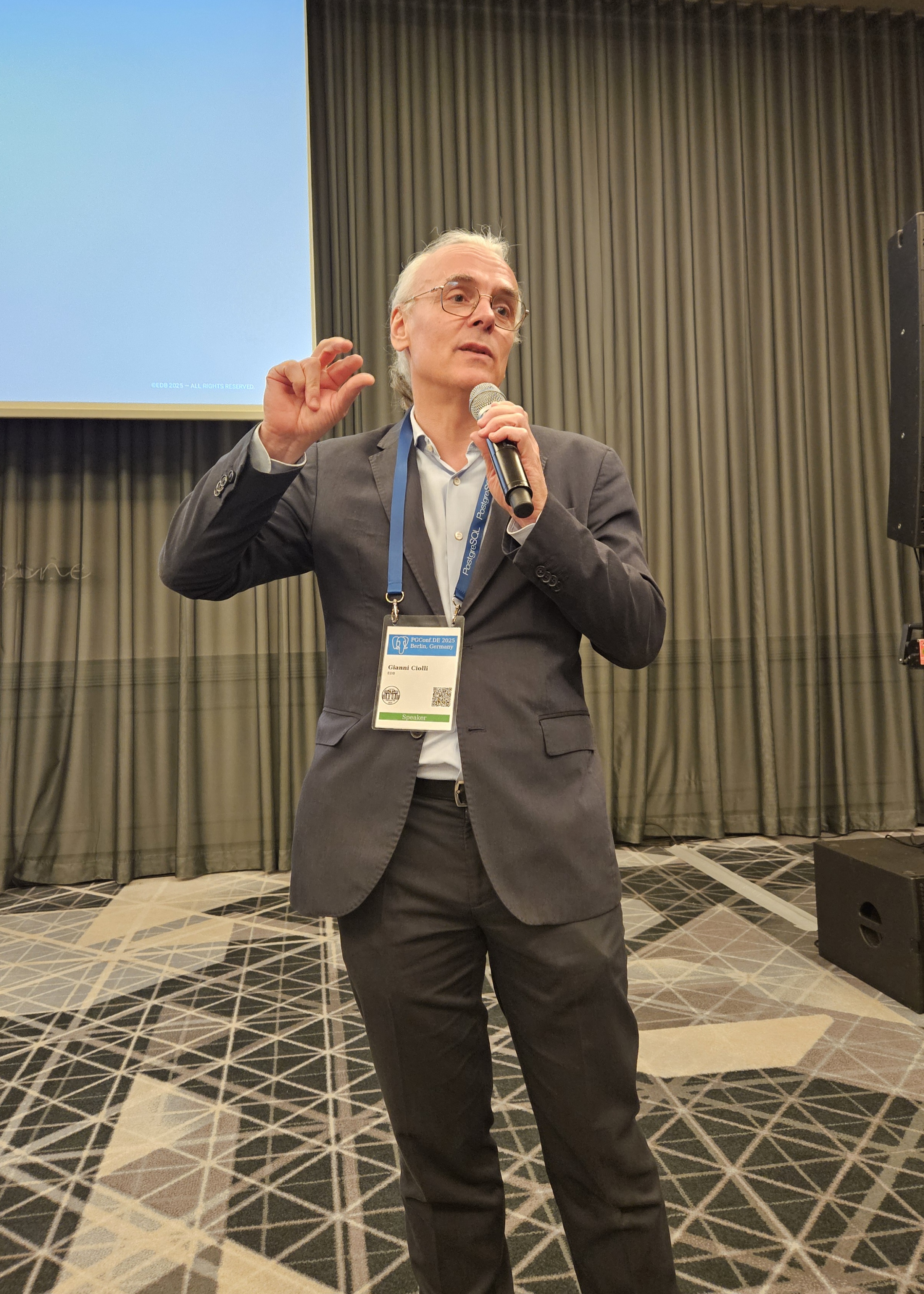 Gianni Ciolli talks about Bach at last year's PGConf DE